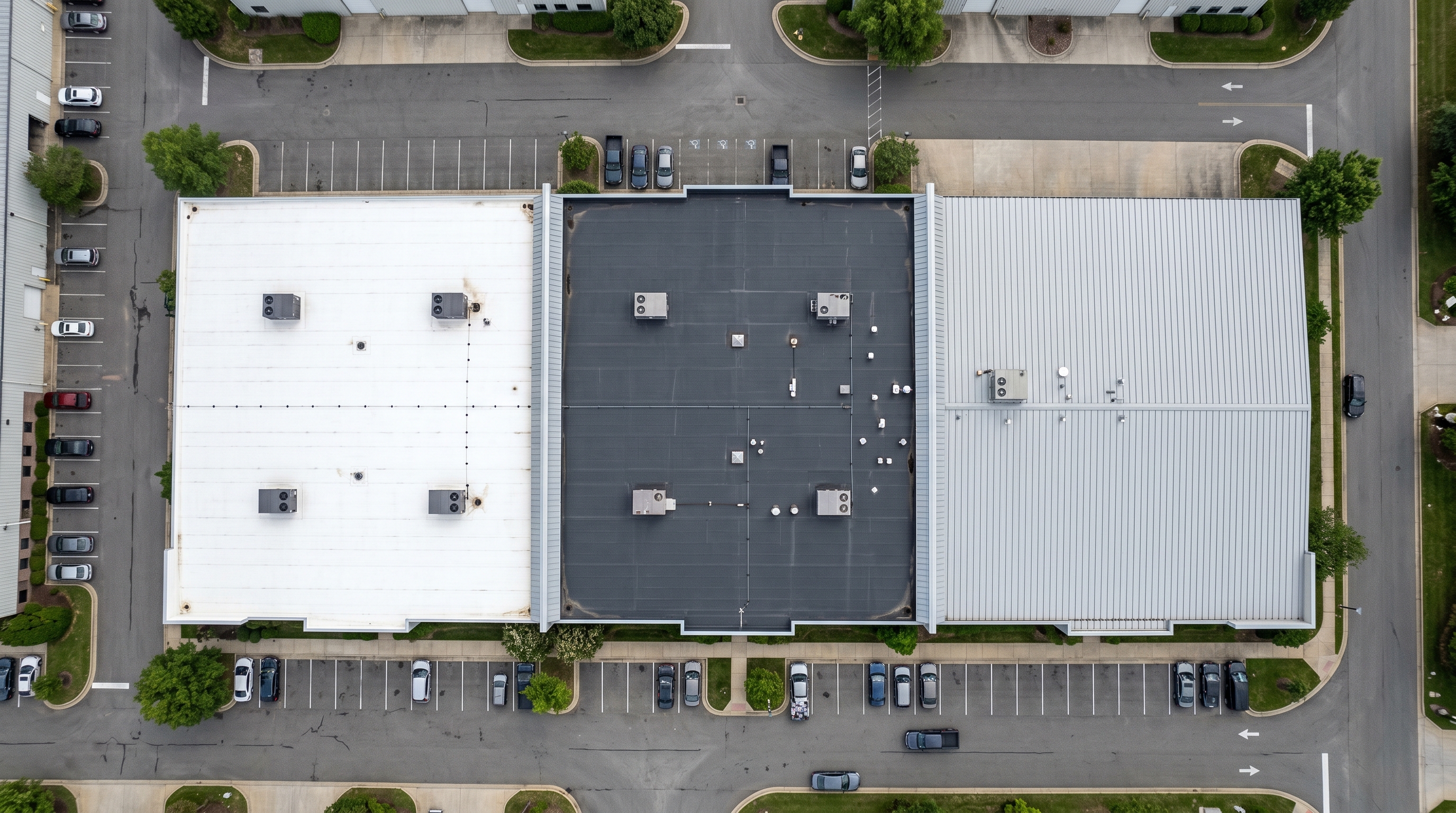
At-a-Glance Comparison
| System | Service Life | 2026 Installed Cost | Slope | Hail Resistance | Best Application |
|---|---|---|---|---|---|
| TPO | 20–30 yrs | $8.50–$14.00 /sf | Low / Flat | Class 3–4 (60-mil+) | Warehouse, retail, office, industrial |
| EPDM | 20–30 yrs | $7.50–$12.50 /sf | Low / Flat | Class 3–4 (60-mil+) | Large simple roofs; cold climates |
| PVC | 20–30 yrs | $9.00–$16.00 /sf | Low / Flat | Class 3–4 | Restaurants, hospitals, chemical exposure |
| Modified Bitumen | 15–25 yrs | $6.00–$10.50 /sf | Low / Flat | Class 3–4 (granulated) | Foot-traffic roofs, multi-ply redundancy |
| Standing Seam Metal | 40–60+ yrs | $12.00–$22.00 /sf | Sloped | Class 4 (galvalume) | Long-hold assets, agricultural, industrial |
| Tile | 40–75 yrs | $15.00–$30.00 /sf | Sloped | Class 3–4 (impact rated) | Architectural, premium retail/hospitality |
| Asphalt Shingles | 20–50 yrs | $5.50–$12.00 /sf | Sloped | Class 4 (impact rated) | Light commercial, multi-family, sloped roofs <4 stories |
| Roof Coatings | 10–20 yrs | $2.00–$7.00 /sf | Low / Flat | Varies by base system | Restoration of sound aging roofs |
Find systems that fit your building
Set your building's parameters below — only matching systems will display. Reset anytime to see all eight.
No systems match all your criteria
Try relaxing one or two filters. Most building situations have multiple viable systems — the goal is to narrow the field, not eliminate it.
TPO (Thermoplastic Polyolefin)
Single-Ply Membrane · Heat-WeldedTPO is the most-installed commercial roof membrane in the United States and the dominant choice for new low-slope commercial construction in the KC metro. It combines a reflective white surface (reducing summer cooling loads) with hot-air-welded seams that, when properly installed, are as strong as the membrane itself. Available in 45-mil, 60-mil, 80-mil, and FleeceBACK formats.
Strengths
- Reflective white surface reduces cooling costs (50–60°F surface temp reduction vs. dark membrane)
- Heat-welded seams resist freeze-thaw better than adhesive seams
- Strong puncture resistance at 60-mil and above
- Widely available, competitive installed cost
- Compatible with most insulation and deck types
Considerations
- TPO is a relatively newer chemistry (~30 yrs) vs. EPDM's 60+ year track record
- Quality varies by manufacturer; stick with major brands
- Requires factory-trained installers with proper welding equipment
- Shows dirt; reflective performance degrades over time without cleaning
EPDM (Ethylene Propylene Diene Monomer)
Single-Ply Membrane · Synthetic RubberEPDM is the original modern single-ply roof membrane and has the longest field track record of any current commercial roofing system — over 60 years of documented in-service performance. The synthetic rubber stays flexible across the full Midwest temperature range, making it especially well-suited to cold-climate applications. Available in 45-mil, 60-mil, and 90-mil thicknesses, in black or white.
Strengths
- Longest documented service history in the industry
- Excellent low-temperature flexibility — ideal for KC winter swings
- Superior UV and ozone resistance
- Lowest entry-level installed cost of major single-ply systems
- Simple repairs with widely available materials
Considerations
- Adhesive seams are weaker than heat-welded seams; freeze-thaw degrades them faster
- Black EPDM absorbs heat (no cooling benefit); white EPDM costs nearly as much as TPO
- *Ballasted EPDM is not recommended in KC's wind zone
- Hail puncture vulnerability at 45-mil thickness
PVC (Polyvinyl Chloride)
Single-Ply Membrane · Heat-WeldedPVC is the premium-tier single-ply membrane: heat-welded seams that are stronger than the membrane itself, exceptional chemical and grease resistance, and superior fire performance. The increased upfront cost is justified for buildings with rooftop chemical or grease exposure, where standard TPO and EPDM degrade rapidly.
Strengths
- Resists grease, oils, acids, alkalis, and most industrial chemicals
- Heat-welded seams are the strongest in the single-ply category
- Superior fire resistance vs. TPO and EPDM
- Reflective white surface for cooling load reduction
- KEE-modified variants (e.g., VersiFlex-E with Elvaloy) extend service life further
Considerations
- Highest upfront cost of single-ply options
- Standard PVC can become brittle in extreme cold over time; specify properly
- Older PVC formulations had plasticizer migration issues; modern formulations resolve this
- Compatibility issues with some asphalt-based products
Modified Bitumen (Mod-Bit / SBS / APP)
Multi-Ply Asphaltic MembraneModified bitumen is the modern descendant of built-up roofing (BUR). Asphalt is "modified" with polymers — SBS (rubberized) for cold climates and flexibility, or APP (plasticized) for heat resistance — and reinforced with fiberglass or polyester. Multi-ply construction (typically 2 or 3 plies) provides redundancy that single-ply systems can't match.
Strengths
- Multi-ply redundancy: a puncture through the cap sheet does not necessarily breach the system
- Granulated cap sheets provide UL 2218 Class 4 hail resistance
- Excellent foot-traffic tolerance — preferred for service-access roofs
- SBS variants flex through Midwest temperature swings
- Field-repairable with widely available materials
Considerations
- Heavier dead load than single-ply systems
- Hot-applied versions require more job-site setup and have safety considerations (open flame for torch applications)
- Granule loss is a leading wear indicator; not always replaceable in place
- Declining pool of qualified hot-asphalt applicators in some markets
Standing Seam Metal
Sloped Roofing System · Concealed FastenerStanding seam metal is the longest-service-life roofing system commonly installed on commercial buildings. Vertical seams run up the slope and are mechanically locked or snap-locked together; fasteners are concealed beneath the seams, eliminating most of the leak paths that plague exposed-fastener systems. Galvalume (zinc-aluminum coated steel) is the standard substrate; copper, zinc, and stainless are premium options.
Strengths
- Longest service life of any standard commercial system — 40–60+ years
- Excellent wind and hail performance
- Concealed fasteners eliminate the most common leak source on metal roofs
- Cool-roof-rated finishes available for energy efficiency
- Fully recyclable at end of life
- Compatible with rooftop solar mounting (clamps, no penetrations)
Considerations
- Highest upfront cost of mainstream commercial systems
- Requires sloped substrate or appropriate sub-framing
- Thermal expansion/contraction must be accommodated in design
- Hail can cause cosmetic dents that don't compromise function but affect appearance
- Specialized installation skills; not every roofer can install correctly
Tile (Concrete & Clay)
Sloped Roofing System · ArchitecturalTile is primarily an architectural choice — Mission, Spanish Mediterranean, and Mediterranean styles depend on it visually. Concrete tile and clay tile both deliver decades of service life, but the actual waterproofing layer is the underlayment beneath; the tile itself is the weather and impact shield. In the Midwest, tile is most common on architecturally significant commercial buildings, premium retail/hospitality, and adaptive-reuse projects.
Strengths
- Distinctive architectural appearance unmatched by any membrane or shingle
- Tile body lasts 40–75 years
- Class A fire rating
- Individual tiles are field-replaceable
- Resists insects, rot, and most decay mechanisms
Considerations
- Heavy: requires structural verification for retrofit, often a deal-breaker on existing buildings
- Highest upfront cost
- Underlayment (the actual waterproofing) typically needs replacement every 20–30 years — a major project under tile
- Tile breakage from hail, foot traffic, and falling debris
- Specialized installation; small applicator pool in the KC market
Asphalt Shingles
Sloped Roofing System · Steep-SlopeAsphalt shingles aren't typically associated with "commercial roofing," but a meaningful share of the commercial market is sloped-roof buildings under four stories: multifamily housing, light commercial, professional offices in residential-style buildings, retail strip centers with mansards, and small religious or institutional buildings. Modern architectural shingles deliver 30–50 year service life with proper installation.
Strengths
- Lowest installed cost of any sloped roofing system
- Class 4 impact-rated options qualify for insurance discounts in KC region
- Wide range of styles and colors
- Large applicator pool — easier to find qualified installers
- Field repairs are simple
Considerations
- Shorter service life than tile or metal
- Hail damage is common in KC region; Class 3 and below shingles do not perform well
- Granule loss accelerates after 15 years
- Color matching for repairs becomes difficult after weathering
- Not appropriate for buildings exceeding 4 stories or those needing flat-roof equipment platforms
Roof Coatings (Acrylic, Silicone, SPF)
Fluid-Applied RestorationRoof coatings are not "another roof system" in the same sense as TPO or metal — they are restoration systems applied over an existing roof to extend its service life. When applied to a sound but aging membrane before significant degradation, a quality coating system can add 10–20 years of service at a fraction of full re-roof cost. Most coating projects also qualify as a maintenance expense rather than a capital improvement, with substantial tax implications.
Strengths
- 30–50% of full re-roof cost
- Often expensable rather than depreciable — significant tax advantage (verify with your CPA)
- Avoids landfill waste of full tear-off
- Faster installation; less disruption to building operations
- Highly reflective; reduces cooling loads immediately
- Silicone resists ponding water; ideal for problem-drainage roofs
Considerations
- Not a fix for a failed roof — must be applied while base system is still sound
- Wet insulation must be removed first; coating cannot encapsulate moisture
- Coating types are not interchangeable; the right type depends on base system and conditions
- Acrylic coatings degrade if exposed to ponding water
- SPF (sprayed polyurethane foam) requires specialized applicator skill
- Recoating is required at end of service life
Decision Matrix — Which System Fits Your Building?
The scenarios below map common building types and ownership situations to the system that typically fits best. These are starting points, not absolute rules — every building deserves a site-specific evaluation.
Likely fit: 60-mil TPO with R-30 polyiso insulation. Wind-vented (Carlisle VacuSeal or WindSmart) worth evaluating on this size.
Likely fit: 60-mil TPO. Standing seam metal at the architectural mansard sections if applicable.
Likely fit: 60-mil PVC. Don't compromise here — TPO and EPDM degrade rapidly under grease exposure.
Likely fit: Coating restoration system (acrylic or silicone) — likely 30–50% of replacement cost; potentially expensable.
Likely fit: Standing seam metal. Highest lifecycle ROI for long-hold assets.
Likely fit: UL 2218 Class 4 architectural asphalt shingles. Likely qualifies for insurance premium discount.
Likely fit: Tile replacement matching original; underlayment upgrade is the main scope. Verify structural capacity if changing tile type.
Likely fit: Wind-vented system (VacuSeal or WindSmart) over a cover board with new TPO or EPDM membrane. Avoids tear-off and works on difficult-to-fasten decks.
Get a Site-Specific Recommendation
Every commercial building has unique conditions that affect which system is the right fit. Evangel Roofing's commercial specialists conduct on-site assessments and provide written, itemized proposals with specific system recommendations for your building, location, and ownership horizon.
Request a Free Site Assessment →System lifespans, costs, and performance characteristics in this comparison reflect general Midwest market conditions in early-to-mid 2026. Actual project pricing and performance depend on specific site conditions, geometry, deck type, existing conditions, access, and scope. Manufacturer product names, certification programs, and warranty terms are accurate to public manufacturer documentation as of April 2026 and are subject to change. UL 2218 and FM 4473 ratings reflect specific test conditions and do not guarantee field performance against any individual hail event. Tax treatment of roof coatings versus replacements depends on individual circumstances; consult a qualified CPA. This guide is intended for general educational purposes and does not constitute engineering, legal, or tax advice.