Midwest Climate Threats
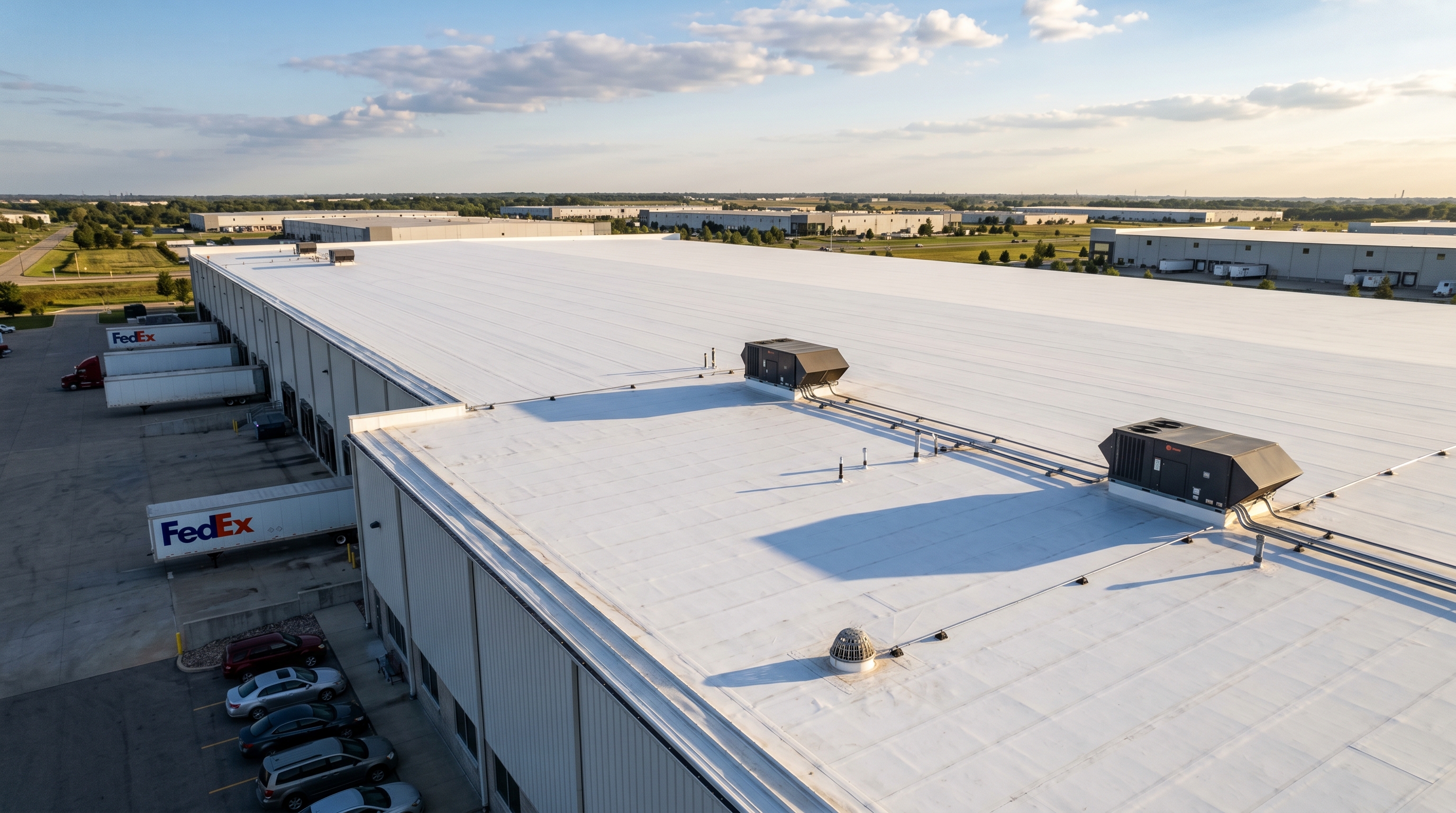
The Kansas City metropolitan area and the surrounding 150-mile service region present one of the most demanding environments for commercial roofing in North America. The combination of large annual temperature swings, frequent severe convective weather, and substantial annual precipitation creates stresses that roofing systems in milder climates rarely encounter.
Climate normals: NWS Kansas City/Pleasant Hill (KEAX) and NOAA NCEI. Wind speed: ASCE 7-22 Risk Category II contour for KC metro. Hail counts: trained spotter reports per Interactive Hail Maps, 2025–2026.
Freeze-Thaw Cycling
Kansas City and surrounding metros experience numerous freeze-thaw cycles each winter season, with daytime highs commonly above freezing and overnight lows well below it. When water penetrates seams, fasteners, or microcracks in a roofing membrane, it expands by roughly 9% upon freezing. Over multiple cycles, this hydraulic pressure widens seams, cracks flashings, and lifts membrane adhesion. EPDM seams that depend on adhesives are particularly vulnerable; hot-air-welded TPO and PVC seams are less so when properly installed.
Hail — The KC Metro Sits in "Hail Alley"
The central Plains corridor — Texas through Nebraska, including all of Kansas, western Missouri, and the KC metro — records more frequent severe hail than nearly any other region in the United States. According to the NWS, the KC area received hail large enough to trigger insurance attention several times in 2025 alone, with stones up to 4 inches in diameter reported during the March 10, 2026 event near Parkville. Standard 45-mil TPO and aged EPDM are vulnerable to puncture from stones above 1.5". NOAA Storm Events Database is the authoritative reference for documenting events that affect a specific property.
Wind Uplift
ASCE 7-22American Society of Civil Engineers Standard 7-22 — the referenced design loads standard for buildings. Adopted by the 2024 IBC. Defines wind, snow, seismic, and other load requirements. designates the Kansas City metro as a 115 mph (3-second gust, Risk Category IIASCE 7's classification of buildings by occupancy and consequence of failure. Risk Cat II covers standard commercial and residential buildings. Cat III covers schools and gathering places; Cat IV covers hospitals and emergency facilities, which are designed to higher wind speeds.) basic wind speed zone. Kansas as a whole ranges from 105 mph in the east to 120 mph in the west; Missouri ranges similarly. Improper fastener spacing, inadequate edge metal, and aged adhesive are the primary causes of wind-driven membrane blow-off. Roof perimeters (Zone 2The perimeter strip of a low-slope roof, typically the outer 10% on each side. Wind uplift forces here are roughly 2× the field of the roof and require enhanced fastening per code.) and corners (Zone 3The corners of a low-slope roof — where two perimeters meet. Uplift forces are roughly 3× the field of the roof. The most failure-prone area of any commercial roof.) experience 2–3× the uplift pressure of the field of the roof and require enhanced fastening per code.
UV Degradation
The KC metro averages roughly 2,790 hours of sunshine annually — well above the U.S. average. Uncoated or dark membranes absorb more solar radiation, accelerating thermal cycling and oxidation. White TPOThermoplastic Polyolefin — a single-ply roof membrane introduced in the 1990s. Now the most-installed commercial membrane in the U.S. due to its reflective white surface and heat-welded seams. and PVCPolyvinyl Chloride — a single-ply membrane known for chemical resistance and the strongest heat-welded seams in the single-ply category. Premium-tier pricing; specified where grease, oils, or chemicals are present on the roof. membranes typically reflect 70–80% of incident solar radiation, reducing rooftop surface temperatures by 50–60°F versus black membranes (Cool Roof Rating CouncilCRRC — independent organization that rates and certifies roof products for solar reflectance and thermal emittance. Required by some energy codes and incentive programs.).
Ponding Water
Low-slope commercial roofs (≤¼" per foot slope) are prone to pondingWater that remains on a roof more than 48 hours after a rain event. Adds approximately 5 lbs/sf per inch of depth. Accelerates membrane degradation and voids most manufacturer warranties. when drains are clogged, undersized, or poorly placed. ASCE 7-22 requires structural analysis for ponding instability where deflection under ponded water exceeds the contributory slope. Standing water for more than 48 hours after a rain event accelerates membrane degradation and voids most manufacturer warranties.
Commercial Roofing Systems Evangel Roofing Installs
Evangel Roofing installs every primary commercial low-slope membrane system, sloped metal and tile, asphalt shingles, and roof coating systems. The right choice for any specific building depends on slope, deck type, equipment density, building use, occupancy schedule, budget, and ownership horizon. The summary below covers each system at a glance; Section 9 covers cost ranges in detail.
| System | Service Life | 2026 Installed Cost | Best For | Midwest Note |
|---|---|---|---|---|
| TPO Thermoplastic Polyolefin |
20–30 yrs | $8.50–$14.00 /sf | Warehouses, retail, office, industrial flat roofs | Hot-air welded seams resist freeze-thaw better than adhesive seams; reflective white surface reduces summer cooling load |
| EPDM Ethylene Propylene Diene Monomer |
20–30 yrs | $7.50–$12.50 /sf | Large, simple low-slope roofs; cold-climate buildings | Excellent flexibility through full Midwest temperature swing; seam integrity is the watch-point |
| Standing Seam Metal | 40–60+ yrs | $12.00–$22.00 /sf | Sloped commercial, industrial, agricultural, long-hold assets | Highest wind and hail resistance in standard product lines; minimum slope and substrate requirements apply |
| Tile (Concrete / Clay) |
40–75 yrs | $15.00–$30.00 /sf | Architectural buildings, mission/Spanish style, premium retail | Heavy dead load; requires structural verification on retrofit; underlayment is the actual waterproofing |
| Asphalt Shingles | 20–50 yrs | $5.50–$12.00 /sf | Sloped commercial, multi-family, light commercial under 4 stories | Specify UL 2218 Class 4 impact-rated shingles for Midwest hail exposure |
| Roof Coatings (Acrylic, Silicone, SPF) |
10–20 yrs (varies) | $2.00–$7.00 /sf | Restoration of sound but aging membranes; tax/expense advantage over capital re-roof | Can extend an existing roof's service life when applied before significant degradation; not a fix for failed roofs |
Cost ranges reflect Q1–Q2 2026 Midwest market data compiled across multiple regional sources, including pricing references from Greater Midwest Exteriors (Chicago metro), Allweather Roof (Minneapolis), and current TPO/EPDM market surveys. Final pricing is project-specific.
Recommendation Framework
For most commercial low-slope roofs in the KC metro, 60-mil TPO is the most installed system in the market for sound reasons: hot-air-welded seams perform better through freeze-thaw cycling than adhesive-based EPDM seams, reflective white surfaces reduce cooling loads in our long sunny summers, and installed cost is competitive.
For buildings with rooftop chemical exposure — restaurants with grease exhaust, manufacturing facilities, hospitals, certain food processors — specify PVC. PVC's heat-welded seams are stronger than the membrane itself, and its chemical resistance is unmatched among single-ply options.
For long-term hold assets with minimal tolerance for re-roofing — owner-occupied corporate facilities, agricultural operations, religious or institutional buildings — evaluate standing seam metal despite higher upfront cost. Service life of 40–60+ years and superior hail/wind performance can produce the lowest lifecycle cost.
Note on membrane thickness: Evangel Roofing recommends a minimum of 60-mil TPO or EPDM for commercial applications anywhere in this service region. The 45-mil membranes commonly used in milder climates are inadequate for Kansas City's hail frequency and freeze-thaw stress. Stepping up to 60-mil typically adds $0.40–$0.60/sf installed and meaningfully extends service life.
Building Codes & Standards
Climate Zone & Energy Code
Kansas City and the bulk of its 150-mile service region are designated IECC / ASHRAE Climate Zone 4A (Mixed-Humid). Counties to the north and the high western edge of the service area transition into Zone 5A. This designation drives minimum insulation R-values for re-roofs and new construction.
| Climate Zone | Coverage in Service Area | Min. Roof R-Value (Continuous) |
|---|---|---|
| Zone 4A | KC metro (both states), most of MO, eastern KS, southern IA | R-30 ci typical |
| Zone 5A | Northern IA, NE, northern MO counties | R-30 ci typical (R-25 ci minimum in some applications) |
"ci" = continuous insulation, placed above the deck rather than between framing members. Most pre-2010 commercial buildings are significantly under-insulated by current code. A re-roofing project is the most cost-effective opportunity to upgrade to compliance.
Local Code Adoption
- Kansas City, MO: Adopts the 2018 International Code package (effective June 28, 2020) with the 2021 International Energy Conservation Code (effective July 1, 2023). Verify current local amendments via the KCMO Building & Rehabilitation Code portal.
- Kansas City, KS / Wyandotte County: Adopts the 2018 IBC. Verify current amendments via the Unified Government's Neighborhood Resource Center, Building Inspection Division.
- Missouri: No statewide building code; codes are adopted locally. Most metros operate on a 6-year cycle.
- Kansas: No mandatory statewide building code. Code adoption varies by city/county; major metros generally adopt the 2018 IBC.
- A permit is required for commercial re-roofing in essentially all jurisdictions across the service region. Inspections typically occur at deck, insulation, and final stages.
Wind Uplift — ASCE 7-22
ASCE 7-22 is the referenced design loads standard. For the Kansas City metro:
- Basic wind speed: 115 mph (3-second gust, Risk Category II)
- Exposure Category: Most urban/suburban commercial sites are Exposure C (open terrain with scattered obstructions); dense urban cores can qualify for Exposure B
- Enhanced fastening zones: Perimeter (Zone 2) and corners (Zone 3) require 2–3× higher fastener density than the field (Zone 1)
- FM Global ratings: Many commercial property insurance policies require an FM 1-90 (or higher) uplift rating; verify your policy before specifying a system
Hail Resistance Ratings
Two rating standards govern impact resistance: UL 2218 (steel ball drop test, Classes 1–4) and FM 4473 (ice ball impact test, Classes 1–4). FM 4470 also addresses Severe Hail (SH) and Very Severe Hail (VSH) classifications for membrane systems.
| Rating | Test Standard | Simulated Hail | Relevance |
|---|---|---|---|
| Class 1 | UL 2218 / FM 4473 | 1.25" | Minimum; inadequate for KC hail frequency |
| Class 2 | UL 2218 / FM 4473 | 1.5" | Moderate protection |
| Class 3 | UL 2218 / FM 4473 | 1.75" | Adequate for many KC events |
| Class 4 | UL 2218 / FM 4473 | 2" | Recommended for KC metro and surrounding region |
Engineered Wind-Vented Systems
Two manufacturers offer engineered wind-vented roofing assemblies — sometimes called pressure-equalized or vent-secured systems. These are loose-laid systems that use specialized vents to create negative pressure under the membrane, "vacuum-locking" the roof to the substrate. The stronger the wind, the tighter the bond.
When to Consider a Wind-Vented System
- Large open roofs where mechanical fastening or full-adhesive installation would be costly or slow
- "Difficult-to-fasten" decks: concrete, gypsum, lightweight insulating concrete, or tectum
- Recover/retrofit projects where a new membrane is being installed over an existing system
- Projects where the building cannot tolerate the disruption, odor, or VOC exposure of fully adhered installations
- Cold-weather installations where traditional adhesives are temperature-restricted
Carlisle SynTec VacuSeal™ Vent Secured System
Carlisle's VacuSeal system uses patented V2T vents made of UV-resistant PVC, with no moving parts and no roof penetrations. The system is compatible with EPDM, TPO, and PVC membranes (60-mil minimum for the 20-year warranty). UL-certified at uplift pressures up to 195 psf negative pressure, with a maximum 20-year Total System Warranty.
Learn more: Carlisle VacuSeal product page →
WindSmart Systems® Wind-Vented Roofing
WindSmart Systems is a separate manufacturer (founded 2013) that licenses its patented WindForce 365® Equalization Vent through approved applicators in partnership with major membrane producers including Johns Manville and Sika Sarnafil. WindSmart publishes UL uplift ratings up to 495 psf on concrete decks, 285 psf on metal decks, and 210 psf on wood decks.
Learn more: WindSmart Systems →
Practical note: Wind-vented systems are not a fit for every project. They require an air-tight substrate and a minimum roof area to perform as engineered. Discuss with a qualified commercial roofing contractor whether your specific building, deck type, and geometry are suitable.
Manufacturer Reference
Evangel Roofing works primarily with the manufacturers listed below. These are the dominant single-ply, modified bitumen, asphaltic, and metal roofing producers in the U.S. commercial market. Each operates an independent contractor certification program with its own warranty offerings.
Carlisle SynTec Systems
Industry leader in single-ply commercial roofing for 50+ years. Full TPO, EPDM, PVC, and FleeceBACK membrane lines, plus polyiso insulation, adhesives, and accessories. Home of the VacuSeal vent-secured system.
Carlisle SynTec →Versico Roofing Systems
Wholly-owned subsidiary of Carlisle Construction Materials (Fortune 500). Top-three U.S. single-ply manufacturer. Product lines include VersiGard® EPDM, VersiWeld® TPO, VersiFlex™ PVC, and VersiFleece® fleece-back membranes.
Versico →Johns Manville (JM)
Berkshire Hathaway company. Full commercial portfolio: TPO, EPDM, PVC, modified bitumen, BUR, and polyiso insulation. Operates the Peak Advantage® Contractor Program with five tiers (Peak → Summit Club → Pinnacle Council → 5280 Council).
JM Commercial Roofing →GAF
North America's largest roofing manufacturer. Full commercial line including EverGuard® TPO, EnergyGuard™ NH polyiso insulation, asphaltic systems, and liquid-applied coatings. Commercial certification ladder: Certified™ → GoldElite™ → PlatinumElite™ → Chairman's Circle.
GAF Commercial →Holcim Elevate (formerly Firestone Building Products)
Holcim acquired Firestone Building Products from Bridgestone in 2021 and rebranded the line to Elevate in mid-2022. RubberGard™ EPDM and UltraPly™ TPO product names continue under the Elevate brand. Now part of Holcim's Building Envelope division.
Holcim Elevate →Manufacturer Certifications — What They Mean
| Certification | Issuing Body | Significance |
|---|---|---|
| Carlisle Authorized Applicator | Carlisle SynTec | Required for Carlisle warranty issuance; annual training requirement |
| Versico Authorized Applicator | Versico Roofing Systems | Required for Versico warranties (5–30 year terms); coverage includes hail to 3", winds to 120 mph |
| JM Peak Advantage® (Peak/Summit/Pinnacle/5280) | Johns Manville | Required for JM Peak Advantage Guarantee; higher tiers offer access to NDL guarantee terms and enhanced training credits |
| GAF Certified™ / GoldElite™ / PlatinumElite™ (Commercial) | GAF | Eligibility tiers for the GAF Diamond Pledge™ NDL Roof Guarantee (up to 25 yrs at GoldElite; up to 35 yrs at PlatinumElite) |
| Holcim Elevate Licensed Applicator | Holcim Elevate | Required for Elevate (formerly Firestone) Red Shield™ warranty issuance |
| FM Approved Contractor | FM Global | Required for FM-rated installations on FM-insured properties |
"NDLNo Dollar Limit — the strongest commercial roofing warranty type. Commits the manufacturer to repair leaks regardless of cumulative repair cost, subject to the warranty terms. Significantly more valuable than "material-only" warranties." = No Dollar Limit. NDL guarantees commit the manufacturer to repair leaks regardless of repair cost, subject to the guarantee terms. Labor-only warranties are significantly less valuable than NDL coverage.
Common Failure Modes
The following patterns account for the majority of premature commercial roof failures observed across the Midwest. Understanding them helps building owners identify problems early and evaluate contractor proposals critically.
1. Seam Failure (EPDM and Aged TPO)
Seams are the most vulnerable point of any single-ply membrane. Adhesive-bonded EPDM seams can delaminate from freeze-thaw cycling, UV exposure, and thermal expansion. Hot-air-welded TPO seams are mechanically superior but can fail from improper weld technique, insufficient temperature, or contamination during installation. Visible signs: gaps or lifting at seams, water staining inside the building below seam locations, blistering near seams after rain.
2. Flashing Deterioration
Flashings — the transition materials at walls, curbs, drains, and penetrations — are the most maintenance-intensive component of any commercial roof. In the Midwest's climate, sealants at flashing joints typically degrade within 5–7 years. Failed flashings are responsible for the majority of active leaks on roofs less than 15 years old, per NRCA field data.
3. Drain Blockage & Ponding
The KC metro's ~38 inches of annual precipitation, combined with leaf drop from regional tree coverage, makes drain maintenance critical. ASCE 7-22 requires emergency overflow drainage (scuppers or secondary drains) on all low-slope commercial roofs. Ponded water adds approximately 5 lbs/sf per inch of depth — significant structural load on spans designed for minimal live load.
4. Membrane Shrinkage (EPDM)
EPDM membranes can shrink slowly over time, pulling flashings away from walls and creating open seams at perimeters. The wide annual temperature range across the KC region accelerates this. Proper installation includes perimeter termination bars and adequate slack — signs of installation deficiencies typically appear within 3–5 years.
5. Insulation Compression & Moisture Intrusion
Once water breaches a membrane, it migrates laterally within insulation boards before appearing as an interior drip — often far from the actual breach. Saturated insulation boards lose R-value and, if not dried out promptly, support mold growth. Infrared thermography is the most reliable non-destructive method for mapping wet insulation.
6. UV-Accelerated Surface Erosion (BUR & Modified Bitumen)
The KC metro's high annual sunshine hours accelerate oxidation of unprotected bituminous surfaces. Granule loss on modified bitumen surfaces is a leading indicator of approaching end of service life. Once the granule layer is depleted, UV degradation of the asphalt matrix accelerates.
Maintenance Schedule
The National Roofing Contractors Association (NRCA) estimates that proactive maintenance can extend commercial roof service life by 25–50% at a typical cost of $0.05–$0.15 per square foot per year — a fraction of the cost of premature replacement.
Recommended Inspection Frequency
- Twice annually: Spring (post-winter freeze-thaw) and Fall (before winter freeze season)
- After any severe weather event: hail ≥¾" diameter, sustained winds ≥58 mph, or any tornado in proximity
- After heavy snowfall: when accumulation exceeds 6" or when ponding is visible during melt
Biannual Inspection Checklist
- All drains clear of debris; drain bowls intact; clamping rings tight
- Scuppers unobstructed; overflow drains functional
- Membrane surface: punctures, blisters, bare spots, or granule loss (modified bitumen)
- All seams: lifted edges, open laps, or visible gaps
- Perimeter flashings and edge metal: secure, no lifting, no open joints
- Curb flashings at HVAC units, skylights, and penetrations
- Pipe boot flashings: cracking, shrinkage, open gaps
- Interior signs: water staining on ceilings, efflorescence on walls below roofline
- Roof surface drainage: standing water 48 hours post-rain indicates a drainage problem
- Expansion joints: sealant condition, cover plate integrity
- Anchor points and walkway pads for rooftop equipment access
- Photograph all deficiencies with date and location for insurance records
Maintenance Cost Benchmarks (Midwest, 2026)
| Maintenance Type | Frequency | Typical Cost |
|---|---|---|
| Professional inspection (with written report) | 2× per year | $400–$850 per visit (varies by roof size) |
| Drain cleaning and clearing | 2–4× per year | $175–$450 per visit |
| Flashing re-caulking (preventive) | Every 5–7 years | $0.10–$0.30 per linear foot |
| Annual maintenance program (inspection + minor repairs) | Annual | $0.10–$0.20 per sf per year |
Evangel Roofing Bi-Annual Maintenance Program
Twice-yearly professional inspection, written report with photo documentation, drain clearing, and minor repairs included. Designed to extend commercial roof service life and preserve manufacturer warranties.
Request Maintenance Program Details →Roof Health Snapshot
A quick, no-cost way to estimate where your commercial roof sits on its service-life curve and what risk profile it represents. Enter what you know about your roof — square footage, system type, age, and recent maintenance pattern — and get an instant assessment with recommended next steps. No pricing, no commitment, no email required to see results.
Where does your roof stand?
Designed for property managers, facility directors, and building owners who need an evidence-based starting point for their roof discussion with ownership.
This tool provides general estimates based on industry-standard service life expectations for each system type. Actual roof condition can only be determined by a qualified inspector. Use these results as a starting point for budget and capital planning conversations, not as a substitute for professional evaluation.
Repair vs. Replace Decision Framework
The decision to repair or replace is rarely simple. The thresholds below are widely used in the commercial roofing industry to structure the analysis.
Indicators for Repair
- Roof is less than 75% through expected service life
- Damage is isolated to less than 25% of total roof area
- Membrane is not saturated; insulation is dry (confirmed by infrared scan)
- Substrate (deck) is sound with no structural compromise
- Repair cost is less than 30% of full replacement cost
- Manufacturer warranty is still active and the damage is repairable under its terms
Indicators for Full Replacement
- Roof exceeds 75% of expected service life
- Multiple active leak locations across more than 25% of the roof
- Wet insulation confirmed in more than 25% of the roof area
- History of repeated repairs at the same locations
- Building use, energy code compliance, or insurance requirements cannot be met without full re-roofing
- Structural deck deterioration requires replacement regardless of membrane condition
The Coating Option (When Applicable)
For roofs that are aging but structurally sound and not yet saturated, a fluid-applied roof coating system (acrylic, silicone, or SPF) can extend service life by 10–20 years at roughly 30–50% of full replacement cost. Coatings work best when applied before significant degradation. They are not a remedy for failed roofs.
The 50% Rule — Insurance Consideration: Some commercial property policies contain provisions or local code "matching" requirements that effectively trigger full replacement when storm damage exceeds a defined threshold of the roof's value. Review your policy and your local AHJ's rules with your insurer or a public adjuster before authorizing storm-related repairs — partial repairs can sometimes inadvertently waive your right to a full replacement claim.
Infrared Thermography
Before committing to full replacement on a roof with isolated leaks, consider commissioning an infrared thermal scan. Performed at dusk after a sunny day, wet insulation retains heat and shows as bright areas on a thermal camera. This non-destructive method maps moisture intrusion accurately and typically costs $0.02–$0.06 per sf — a small investment that can prevent over-specifying a full replacement when targeted repair would suffice.
Maintenance Impact Calculator
The NRCA estimates that proactive maintenance extends commercial roof service life by 25–50%. This calculator translates that range into specific years for your roof — based on its system type, age, and current maintenance pattern — so you can quantify the value of an investment in maintenance versus the cost of running to failure.
How much life can maintenance add?
A practical projection of how a structured maintenance program affects total service life — useful for capital planning and for the conversation with ownership about preventive vs. reactive spending.
Service life impact estimates are based on general industry research, including NRCA service-life guidance and manufacturer field performance data. Individual roof outcomes vary based on installation quality, environmental exposure, and the specific scope of maintenance work. Use as a planning aid, not as a guarantee of future performance.
2026 Cost Ranges — Midwest Region
The figures below reflect installed costs for commercial roofing in the Kansas City metro and surrounding Midwest markets in early-to-mid 2026. Prices vary based on roof complexity, access, existing conditions, material lead times, and scope.
| System | Low | Mid | High | Notes |
|---|---|---|---|---|
| TPO (60-mil, mechanically attached) | $8.50 | $11.00 | $14.00 | Per sf installed; includes R-30 polyiso insulation |
| EPDM (60-mil, fully adhered) | $7.50 | $10.00 | $12.50 | Fully adhered adds ~$1/sf vs. mechanically attached; ballasted not recommended in KC wind zone |
| PVC (60-mil) | $9.00 | $12.00 | $16.00 | Premium for chemical resistance and seam strength |
| Modified Bitumen (2-ply SBS) | $6.00 | $8.00 | $10.50 | Granulated cap sheet standard; hot-applied preferred over cold-process |
| Standing Seam Metal (Galvalume) | $12.00 | $16.00 | $22.00 | Requires minimum slope; 40–60 yr service life justifies premium for hold assets |
| BUR (4-ply) | $6.00 | $7.50 | $9.50 | Declining availability of qualified hot-asphalt applicators |
| Roof Coating Restoration | $2.00 | $4.50 | $7.00 | Per sf installed; system depends on existing membrane and condition |
Additional Cost Factors
- Tear-off and disposal: add $1.00–$2.00/sf if removing one or two existing membranes
- Deck repair: $4.00–$10.00/sf for rotted or damaged sections; steel deck replacement $7.00–$14.00/sf
- Insulation upgrade to current code: upgrading from R-15 to R-30 ci typically adds $2.00–$3.50/sf
- Rooftop equipment curbs: $500–$1,200 per curb for HVAC units or skylights
- Roof access hatch: $1,000–$2,200 installed
- Manufacturer extended warranty (NDL, 20–30 year): typically adds $0.13–$0.20/sf depending on manufacturer and term
These are general market ranges. Final pricing depends on site conditions, complexity, access, material lead times, and scope. Always obtain a written, itemized proposal and verify what is and is not included.
Vetting a Commercial Roofing Contractor
The roofing trade has a low barrier to entry and a high contractor failure rate. The criteria below distinguish qualified commercial roofing firms from inadequate ones.
Non-Negotiable Requirements
- Kansas Roofing Registration (for any work in Kansas): Under the Kansas Roofing Registration Act of 2013, every roofing contractor performing commercial or residential roofing for a fee in Kansas must hold a valid registration certificate from the Office of the Kansas Attorney General. Verify directly at ag.ks.gov. A contractor's claim is not enough.
- Local municipal licensing: In addition to the statewide Kansas Roofing Registration, most cities and counties (Johnson County's Class DR, Lawrence's Class D, Wichita/Sedgwick County's Class A/B/C, KCMO's contractor licensing, etc.) impose their own additional licensing or registration requirements. Always verify both state registration and local licensing with the AHJ for your project location.
- General liability insurance: minimum $1 million per occurrence, $2 million aggregate for commercial work. Request a certificate of insurance naming your entity as additional insured.
- Workers' compensation insurance: mandatory in Kansas and Missouri for businesses meeting employee/payroll thresholds. Request a current certificate. If a worker is injured on an uninsured contractor's job, the building owner can be exposed.
- OSHA 10 or 30 certified field crew: commercial roofing is one of the highest-risk construction trades. A documented safety culture correlates directly with workmanship quality.
Questions to Ask Before Signing
- Who will be performing the installation — your employees, or subcontractors? If subcontractors, verify they hold their own insurance and registration.
- Which manufacturer warranty will you provide, and what is excluded? "Material-only" warranties are significantly less valuable than NDL system guarantees.
- Can you provide three commercial references from similar building types, with contact information?
- What is your process for managing and protecting building contents, occupants, and operations during a re-roof?
- How do you handle unforeseen deck damage discovered after tear-off? Get unit pricing in the contract before work begins.
- Will you provide a written workmanship warranty (5–10 years is standard) in addition to the manufacturer's material warranty?
- Are you registered with the Kansas AG's Roofing Registration Unit (KS work) and licensed with the relevant municipal authority for our project's location?
- What manufacturer certification levels does your company hold?
Storm Damage & Insurance Claims
The KC metro's hail frequency makes commercial roof insurance claims a routine part of building ownership. Understanding the process protects your claim rights and your recovery amount.
Immediately After a Storm Event
- Document the event date and pull NOAA storm reports for your property's exact location at ncei.noaa.gov/stormevents
- Photograph and video the entire roof surface before any repairs — close-ups of impact marks, dents in metal components (HVAC units, flashings, gutters), and any visible membrane damage
- Photograph interior water intrusion with date-stamped images
- Notify your insurance carrier in writing within the timeframe specified in your policy — typically prompt notice; commonly 30–60 days from event
- Make only emergency temporary repairs (tarping, drain clearing) until the adjuster has inspected
What Insurance Adjusters Evaluate
- Density and pattern of hail strikes (random pattern indicates a weather event vs. mechanical damage)
- Spatter marks on soft metals (HVAC fins, gutters, downspouts) as corroborating evidence
- Functional vs. cosmetic damage distinction — a critical and frequently disputed point
- Age and condition of the membrane before the storm (pre-existing damage vs. storm damage)
- Applicable depreciation under an ACV vs. RCV policy
ACV vs. RCV Policies
Replacement Cost Value (RCV): pays to replace with new materials of like kind and quality. Most favorable for building owners.
Actual Cash Value (ACV): deducts depreciation based on the roof's age and pre-loss condition. On a 15-year-old roof, this can reduce the payout to 30–40% of replacement cost. Review your policy and consider negotiating an upgrade to RCV coverage at renewal where available.
Typical Claims Timeline
- Notify carrier → adjuster assigned (1–3 weeks; longer in high-volume storm periods)
- Adjuster inspection → estimate issued (1–4 weeks)
- Dispute scope if necessary — you have the right to a public adjuster or to invoke the policy's appraisal process
- Settlement → contractor work begins
- Recoverable depreciation released upon proof of completion (RCV policies)
This guide is intended for general educational purposes only. Building codes, material costs, and insurance regulations are subject to change. All specific requirements should be verified with the applicable Authority Having Jurisdiction (AHJ) and a licensed professional for your specific property and circumstances. Pricing ranges reflect general Midwest market conditions in early-to-mid 2026 and will vary by project. Manufacturer product names, certification levels, and warranty terms are accurate to public manufacturer documentation as of April 2026 and are subject to change by the manufacturer. Evangel Roofing LLC does not guarantee any specific outcome on any insurance claim or specific project.