Patch budgets add up fast. Here's a practical framework for property managers to decide when continuing to repair a commercial roof is costing more than a planned replacement.
How Do You Know When Repair Is No Longer the Right Answer?
The most reliable indicator that a commercial roof has crossed from repair territory into replacement territory is cumulative cost relative to replacement value. The standard industry threshold: when total repair costs over the last five years have reached 25–30% of the estimated replacement cost, replacement typically delivers better long-term economics than continued patching. This is sometimes called the "25% rule" among commercial roofing advisors.
Beyond the financial threshold, there are physical warning signs that no amount of repair work can sustainably address: widespread membrane delamination, saturated insulation across large sections of the roof field, structural deck deterioration from prolonged moisture infiltration, and seam failures along a significant percentage of the roof's linear footage. When these conditions are present, each patch creates new stress points adjacent to the repaired area.
What Are the Critical Warning Signs of a Failing Commercial Roof?
Property managers in Kansas City should conduct visual inspections twice per year — spring and fall — and after every major storm event. The following conditions, when found in multiple locations across the roof, typically indicate systemic failure rather than isolated repair needs.
- Standing water (ponding) 48+ hours after rainfall — indicates drainage failure or structural deflection
- Interior ceiling stains appearing in locations that have been repaired before — indicates the leak source has migrated
- Membrane blistering or bubbling across large areas — indicates trapped moisture in the insulation layer
- Open or cracked seams spanning more than a few linear feet — indicates widespread adhesive or weld failure
- Visible separation around penetrations (HVAC curbs, drains, skylights) at multiple locations
- Soft spots when walking the roof — indicates saturated or deteriorated insulation beneath the membrane
- Drain channels and scupper openings holding debris and water consistently
How Does Building Age Affect the Repair vs. Replacement Decision?
Age alone doesn't determine when a commercial roof should be replaced — installation quality, maintenance history, and storm exposure matter just as much. However, age provides important context for evaluating repair ROI. A membrane that is 8 years old with significant damage likely warrants repair; the same damage on a 22-year-old roof of the same type represents a much weaker case for repair investment.
For Kansas City property managers evaluating an older roof, the practical question is: how many service years does a repair buy, and at what cost per year? If a $12,000 repair buys three to five reliable years on a roof nearing end of life, that may still be the right call while capital budget is planned for replacement. If the same repair only provides 18 months of reliability, the repair math breaks down.
What Is the Financial Case for Replacement Over Continued Patching?
Persistent repair cycles create hidden costs beyond the direct invoice: emergency response premiums (emergency repairs cost 40–60% more than scheduled work), interior damage from moisture infiltration, HVAC inefficiency from degraded insulation R-value, tenant or operational disruption from repeated leak events, and accelerating damage to the structural deck below the membrane.
A properly planned re-roofing project — with adequate lead time for scope development, material procurement, and scheduling — typically costs 20–30% less than emergency replacement driven by a catastrophic failure event. Evangel works with property managers in the Kansas City region to develop capital replacement forecasts so that re-roofing can be budgeted and planned rather than forced.
What Does a Professional Commercial Roof Inspection Reveal?
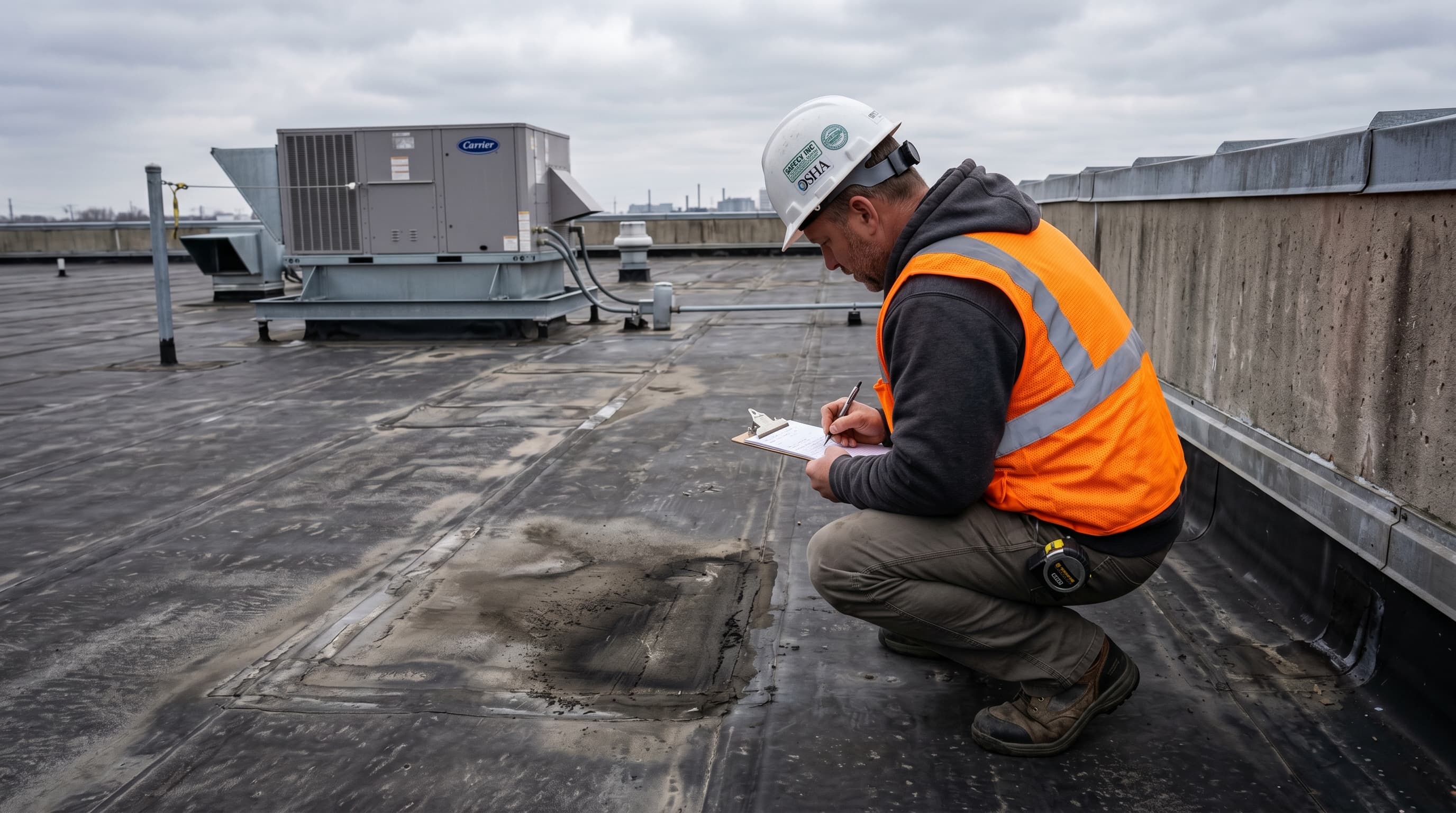
A professional commercial roof inspection goes significantly beyond what a visual walkthrough detects. Infrared thermography can identify saturated insulation sections that show no visible membrane damage — these are the areas that quietly expand every winter as trapped moisture freezes and thaws. Core cuts reveal the actual condition of insulation layers and confirm whether the deck below is compromised. Seam probing identifies adhesive or weld failures before they become active leaks.
Evangel provides written inspection reports for all assessments, documenting the condition of each roof zone with photographs and a repair/replacement recommendation with supporting cost data. For properties under a maintenance program, this documentation creates a reliable record that supports capital planning and insurance claim substantiation.
How Long Does a Commercial Roof Replacement Take in Kansas City?
For most commercial buildings in the Kansas City metro ranging from 10,000 to 50,000 sq ft, a full re-roofing project — tear-off of existing membrane, inspection and spot replacement of damaged insulation, new membrane installation, and seaming — runs 3 to 10 working days depending on building complexity and weather. Evangel coordinates directly with tenants and property management teams on phasing when a full project timeline isn't feasible without disruption.
Weather is the primary wildcard. Kansas City's spring season, while ideal for scheduling, carries storm risk that can pause field work. Evangel monitors forecasts and stages materials to minimize delays.
Frequently Asked Questions
How often should a commercial roof be replaced?
Commercial roofing systems typically last 20–30 years depending on material type, installation quality, and maintenance history. Most property managers should plan for a re-roofing evaluation at year 18–22 for TPO and PVC systems, and year 15–20 for EPDM systems, accounting for Kansas City's climate exposure.
What is the 25% rule in commercial roofing?
The 25% rule suggests that once cumulative repair costs over five years approach 25–30% of the estimated replacement cost, a full replacement typically delivers better long-term economics than continued repairs. This threshold is a starting point for analysis, not a hard rule — building condition, remaining lifespan, and capital timing all factor in.
Can a commercial roof be repaired instead of replaced after storm damage?
In many cases, yes — especially when storm damage is localized. An insurance adjuster and a qualified commercial roofer should evaluate the scope together. If storm damage covers more than 25–30% of the roof field, most insurers will approve a full replacement rather than a partial repair that leaves compromised membrane in place.
How much does commercial roof replacement cost in Kansas City?
Commercial re-roofing costs in the Kansas City area typically range from $8 to $18 per square foot depending on membrane type, insulation requirements, tear-off scope, and building complexity. Evangel provides free on-site estimates for all commercial properties within 150 miles of Kansas City — no square footage estimates over the phone.